

Construction, maintenance, warehousing, facility management, and industrial operations often require workers to access elevated areas safely and efficiently.
Choosing the right machinery for these tasks can influence productivity, site organization, and overall operational efficiency.
In Singapore, where many projects are carried out in compact urban environments, businesses often need equipment that can operate effectively within limited spaces while still meeting project requirements.
From forklifts and boom lifts to scissor lifts, mobile scaffolding, and power generators, each type of equipment serves a different purpose. Understanding these differences can help project managers, contractors, and facility operators select equipment that is more suitable for their work environment.
ADVERTISEMENT
SCROLL TO RESUME CONTENT
Why Equipment Selection Matters
Heavy machinery is not simply about lifting heavier loads or reaching greater heights. The equipment must match the specific working conditions of a site.
A machine that performs well outdoors may not necessarily be suitable for indoor use. Similarly, equipment designed for vertical access may not be appropriate when workers need to reach areas located horizontally away from the machine’s base.
Before selecting equipment, several factors should be considered:
- Required working height
- Indoor or outdoor use
- Available floor space
- Ground conditions
- Load capacity
- Number of workers using the platform
- Frequency of equipment use
- Duration of the project
- Access limitations
- Power requirements
Understanding these factors can help companies avoid choosing machinery that is either oversized or unsuitable for the task.
Common Types of Industrial Equipment
Different projects require different equipment. Some machinery is designed primarily for material handling, while others are intended to provide temporary access to elevated working areas.
Forklifts
Forklifts are widely used in warehouses, factories, logistics centers, construction sites, and distribution facilities.
Their primary purpose is to move materials over relatively short distances. Pallets, construction materials, machinery components, and other heavy items can be transported more efficiently using the correct forklift.
When choosing a forklift, operators should consider load capacity, lifting height, turning radius, operating environment, and available space.
For example, a warehouse with narrow aisles may require a different forklift configuration from an outdoor construction site.
Boom Lifts
Boom lifts are commonly used when workers need both vertical and horizontal access.
Unlike equipment that moves primarily upward, boom lifts have articulated or telescopic arms that allow the platform to extend outward.
This makes them useful for applications such as:
- Building maintenance
- Exterior installation work
- Electrical maintenance
- Signage installation
- Construction activities
- Industrial facility maintenance
Their ability to reach around obstacles can make boom lifts suitable for work areas where direct vertical access is not possible.
However, space requirements, terrain conditions, working height, and site restrictions should always be assessed before equipment is deployed.
Scissor Lifts
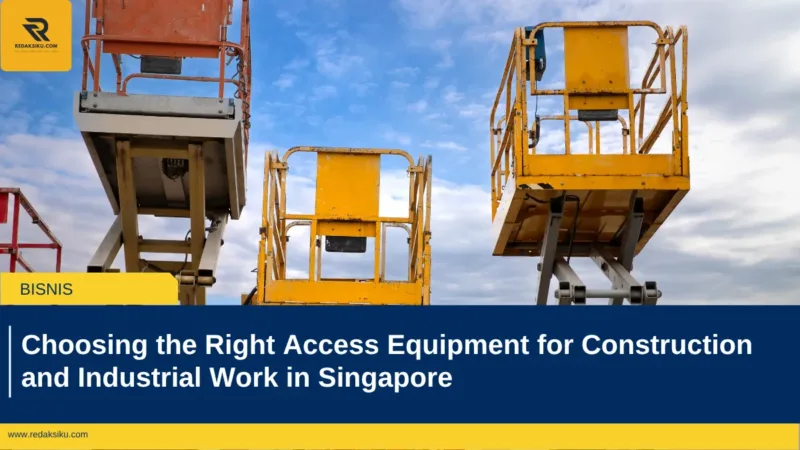
Scissor lifts are designed primarily for vertical access. Their platform moves upward using a crossed support mechanism that expands as the lift rises.
One of their main advantages is the relatively spacious working platform, which can allow workers to bring tools, materials, or other equipment to elevated working areas.
Typical uses include:
- Electrical installation
- Ceiling maintenance
- Warehouse operations
- Building services
- Mechanical installation
- Painting
- Facility maintenance
- Construction projects
Businesses looking for temporary elevated access can consider Scissor Lifts Rental Singapore when comparing equipment options for short-term or project-based requirements.
Rental can be useful when machinery is needed only during certain stages of a project rather than throughout the year.
Mobile Scaffolding
Mobile scaffolding provides another option for working at elevated areas.
Unlike powered access platforms, mobile scaffolding generally relies on a structural frame that can be repositioned around a worksite.
It may be suitable for tasks that require workers to remain at the same height for an extended period.
Common applications include:
- Interior renovation
- Painting
- Ceiling work
- Installation projects
- Maintenance
- Mechanical and electrical work
The decision between scaffolding and powered access equipment depends on the nature of the job, required mobility, working height, available floor space, and project duration.

Power Generators
Reliable electricity is essential for many construction and industrial activities.
Power generators can provide temporary electrical supply in situations where permanent power infrastructure is unavailable, insufficient, or temporarily interrupted.
Generators are commonly used for:
- Construction tools
- Temporary lighting
- Site offices
- Industrial equipment
- Events
- Emergency backup applications
Selecting a generator requires an understanding of the total electrical load that will be connected.
Using a generator that is significantly undersized may cause operating problems, while choosing one that is unnecessarily large may increase fuel and rental costs.
Renting or Buying: Which Option Makes More Sense?
Businesses often need to decide whether to purchase equipment or rent it.
There is no single answer that applies to every company.
Buying Equipment
Purchasing machinery may be suitable when equipment is used regularly over a long period.
Ownership can provide greater availability because the machinery remains under the company’s control.
However, businesses must also consider:
- Initial investment
- Storage
- Preventive maintenance
- Repairs
- Equipment depreciation
- Inspection requirements
- Replacement planning
Companies with consistent equipment requirements may find ownership practical if machinery utilization remains high.
Renting Equipment
Rental can provide greater flexibility for project-based operations.
Instead of purchasing machinery for occasional use, companies can obtain equipment when needed and return it after completing the project.
Rental may be useful for:
- Short-term projects
- Temporary increases in workload
- Specialized equipment requirements
- Seasonal work
- Testing equipment before purchasing
- Projects with changing machinery requirements
The final decision should consider total usage, project length, financial planning, maintenance responsibilities, and operational requirements.
Why Maintenance Should Not Be Overlooked
Even high-quality machinery requires regular maintenance.
Mechanical components, hydraulic systems, electrical systems, safety devices, tyres, batteries, and other parts can experience wear during normal operation.
Routine servicing helps identify potential issues before they develop into larger mechanical problems.
Maintenance may involve:
- Visual inspection
- Hydraulic system checks
- Battery inspection
- Lubrication
- Fluid checks
- Electrical system testing
- Safety control testing
- Tyre inspection
- Replacement of worn components
Maintenance requirements vary depending on the machine, manufacturer recommendations, usage frequency, and operating environment.
Keeping proper service records can also help companies monitor equipment condition throughout its operational life.
Safety Considerations When Using Access Equipment
Equipment selection should always include safety considerations.
Only trained or appropriately authorized personnel should operate machinery where required, and operators should understand the manufacturer’s instructions and site-specific procedures.
Before operating access equipment, workers should inspect the surrounding area for potential hazards such as:
- Uneven surfaces
- Overhead structures
- Electrical cables
- Vehicle traffic
- Restricted access
- Floor loading limitations
- Weather conditions
- Nearby machinery
Equipment should also be inspected before use.
Any visible damage, unusual movement, warning indicator, hydraulic leak, or malfunction should be evaluated before operations continue.
Consider the Working Environment
Singapore projects can involve a wide range of operating environments, from indoor warehouses and commercial buildings to construction sites and industrial facilities.
Indoor projects may require compact equipment with low noise levels and suitable power systems.
Outdoor projects, meanwhile, may involve uneven terrain, weather exposure, and longer working distances.
Site assessments can help determine which machinery configuration is appropriate.
For example, a compact electric scissor lift may suit indoor maintenance work, while other projects may require equipment designed for more demanding outdoor surfaces.
Equipment Dimensions Are Important
One detail that is sometimes overlooked is the physical size of the machinery.
A lift may provide sufficient working height but still be unsuitable if it cannot pass through doors, corridors, loading areas, or access gates.
Before selecting equipment, check:
- Machine width
- Machine height
- Platform dimensions
- Turning radius
- Ground clearance
- Transport dimensions
- Entrance dimensions
These measurements can prevent logistical problems once the equipment reaches the worksite.
Understanding Load Capacity
Load capacity is another important consideration.
For elevated platforms, the total load can include workers, tools, materials, and equipment.
Operators should never assume that a platform can carry additional weight simply because there is physical space available.
The manufacturer’s rated capacity should always be followed.
The same principle applies to forklifts. Maximum lifting capacity may change depending on load position, mast height, and attachment configuration.
The Role of an Equipment Supplier
Selecting machinery often involves more than choosing a model from a catalogue.
A supplier can help businesses identify equipment based on working height, application, environment, project duration, and site limitations.
Companies may also prefer suppliers that provide multiple services because equipment requirements can change throughout a project.
RR Machinery provides industrial machinery solutions in Singapore, including sales, rental, servicing, and support for equipment such as forklifts, boom lifts, scissor lifts, mobile scaffolding, and power generators.
Having access to multiple equipment categories can make it easier for businesses to compare machinery based on actual operational requirements rather than relying on a single type of equipment.
Questions to Ask Before Selecting Machinery
Before arranging equipment for a project, it can be helpful to answer several practical questions.
What working height is required?
Will the machinery operate indoors or outdoors?
How much space is available?
What is the floor or ground condition?
How many workers will use the platform?
What tools and materials need to be carried?
How long will the equipment be required?
Is electrical power available at the site?
Does the machine need to travel between different work areas?
Are there height, width, or access restrictions?
Answering these questions can significantly narrow the available equipment choices.
Avoid Selecting Equipment Based Only on Price
Cost is important, but the lowest-priced option is not always the most suitable.
An incorrectly selected machine may create delays, require replacement, or make the work more difficult than necessary.
Businesses should compare equipment based on:
- Suitability for the task
- Machine condition
- Required capacity
- Working height
- Service support
- Maintenance condition
- Rental terms
- Transportation requirements
- Project duration
Evaluating the overall operational value of the equipment provides a better basis for decision-making than comparing price alone.
Conclusion
Choosing the right industrial or access equipment requires a clear understanding of the worksite, project requirements, and machinery capabilities.
Forklifts are commonly used for material handling, while boom lifts provide extended access around obstacles. Scissor lifts are useful for vertical work with larger platforms, mobile scaffolding offers a more traditional access solution, and generators provide temporary electrical power where required.
Businesses should also evaluate whether purchasing or renting is more appropriate based on equipment utilization and project duration.
By considering factors such as working height, load capacity, dimensions, operating environment, maintenance, and safety requirements, companies can make better-informed equipment decisions and organize their projects more efficiently.